On October 18, 2025, the 2025 Annual Conference of the chinese Association for Latin American Studies and the Symposium on “China-Latin America Relations: New Opportunities and New Challenges ” successfully concluded at Zhejiang International Studies University. Hu Qinhua, Member of the Party Committee and Vice President of Dongguan University of Technology, and Chairman of the Board of the entity operating the China-LAC Technology Transfer Center (CLTTC), was invited to attend and deliver closing remarks. He was accompanied by Chen Baiman, Executive Director of the CLTTC, and Zhou Chang, Researcher from the Latin America Research Institute of the CLTTC.
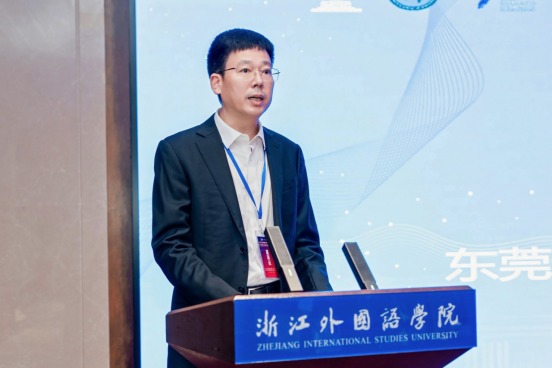
Hu Qinhua delivering the speech
In his address, Mr. Hu noted that the conference explored pressing issues including global power dynamics, the evolution of regional governance, China-LAC economic cooperation, green transformation, and digital governance, offering fresh perspectives for promoting high-quality development in China-LAC relations. He emphasized that Dongguan University of Technology, as the initiating institution and Chair of the entity operating the CLTTC, actively promotes sci-tech cooperation and exchange between China and LAC. This includes advancing the construction of the Belt and Road joint laboratory and, through the Latin America Research Institute, pooling multidisciplinary expertise to build a China-LAC strategic think tank with international influence, whose efforts provide intellectual support and decision-making reference for the synergistic development of industry, academia, and research between China and LAC.
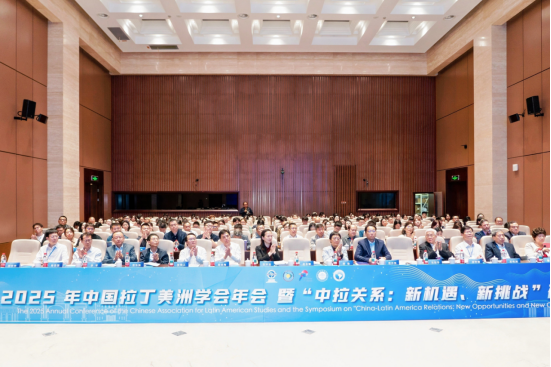
Scene from the conference
Established in 1984, the Chinese Association for Latin American Studies is a national, academic, and non-profit social organization composed of research institutions, universities, enterprises, public institutions, and individuals dedicated to the study of Latin America and the Caribbean. It is committed to integrating research capabilities nationwide, incorporating newly established research institutions, promoting academic exchange and cooperation, supporting the development of universities and think tanks, and enhancing the overall standard of Latin American studies in China.